
Should We Move to the Cloud?
Why Many Organizations Are Still Running On-Prem and How to Know if It’s Time to Shift
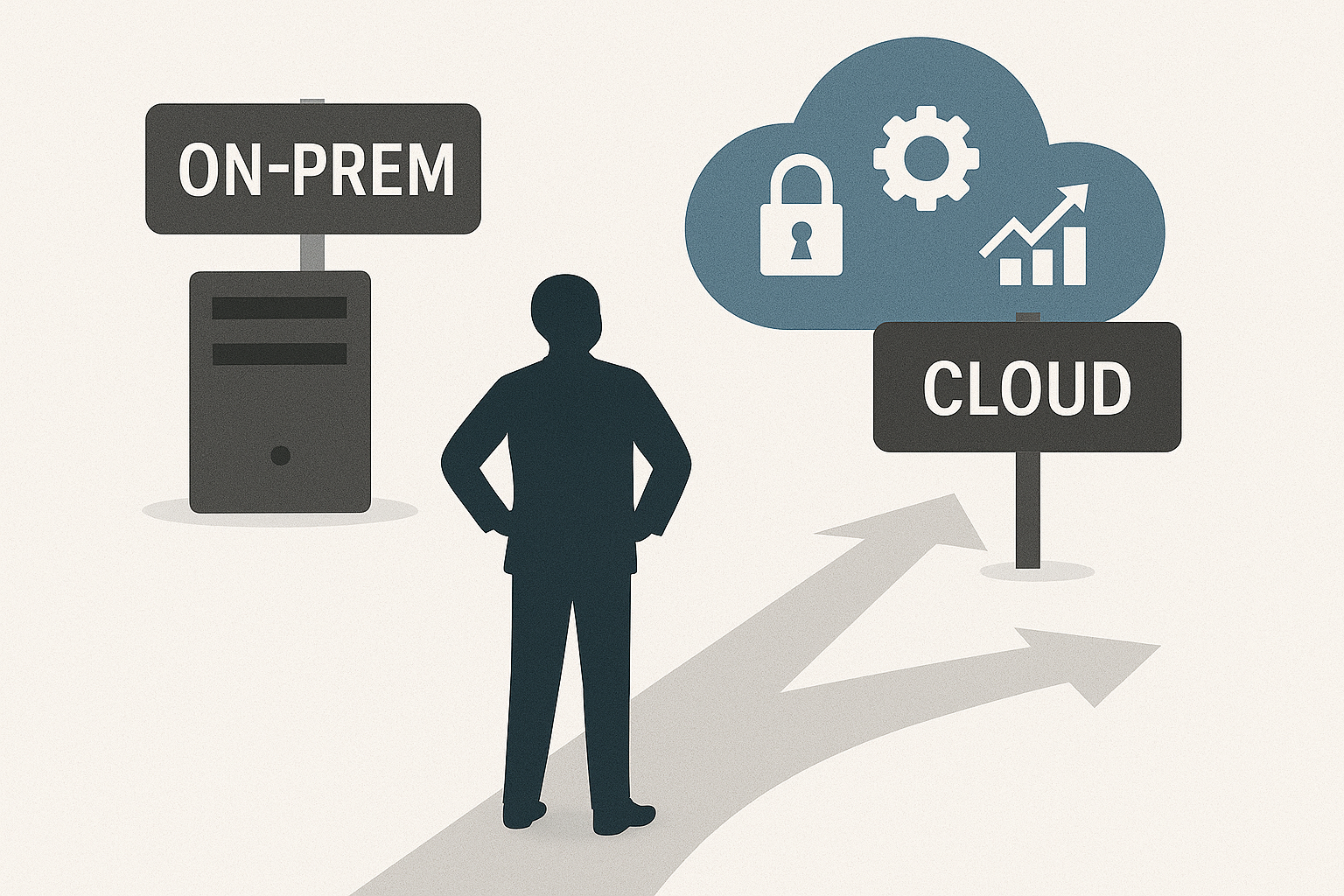
A few months ago, we sat down with the leadership team of a mid-sized financial services firm who posed a deceptively simple question: “Should we be moving to the cloud?” They weren’t asking whether the cloud was powerful, scalable, or modern—they already knew that. What they really meant was: Is the cloud right for us? Right now? And how do we even begin to answer that?
They’re not alone. In 2025, despite years of cloud-first hype, we’re still seeing many organizations—especially those in regulated industries, complex environments, or tight budget cycles—running critical systems on-premises and not entirely sure how (or whether) to make the leap.
The cloud may be mainstream, but the decision to move to it still isn’t.
This article explores what’s driving that hesitation, what questions leaders should ask before making the move, and what a modern, practical cloud strategy can actually look like.
The Myth: “Everyone’s Already in the Cloud”
It’s easy to assume cloud is now the default. And in many ways, it is—especially for new companies, software startups, and digital-first service providers. But for established businesses, particularly in sectors like healthcare, education, manufacturing, logistics, or financial services, the picture is much more complicated.
Plenty of organizations are still:
- Running on-premises ERP or EHR systems
- Hosting file servers locally for compliance or performance reasons
- Operating legacy line-of-business applications that aren’t cloud-ready
- Maintaining internal data centers due to sunk infrastructure costs
And many of them are doing just fine—until they’re not.
The challenge comes when a system needs to scale, integrate with new tools, serve a remote workforce, or meet evolving compliance and security requirements. That’s when the “should we move to the cloud?” conversation starts again.
Why Organizations Are Still Hesitant
From our work in IT assessments and digital transformation planning, we see five common reasons why organizations delay cloud migration:
- Cost uncertainty
It’s not that the cloud is necessarily more expensive—it’s that cloud cost structures are different, and many finance teams are wary of ongoing usage-based billing versus one-time CapEx. Without proper visibility and governance, cloud costs can spike quickly. - Fear of disruption
Mission-critical systems that have been running reliably for years (even decades) can feel risky to touch. Leaders worry: What if something breaks in the transition? What if performance degrades? What if staff can’t support it? - Technical debt and legacy systems
Some apps simply weren’t built for the cloud. They may rely on local databases, outdated dependencies, or architecture that doesn’t map well to IaaS or SaaS models. - Data residency and compliance concerns
Especially in Canada, questions about where data is stored and how it’s protected under local privacy laws remain key blockers—particularly in healthcare, education, and government-funded sectors. - Internal skill gaps
Even organizations with strong IT teams may lack cloud-specific skills—like Azure cost optimization, AWS identity policies, or DevOps automation—making them hesitant to migrate without external support.
The Real Question Isn’t “Should We Move?” It’s “What Should Move—and Why?”
When we hear the phrase “move to the cloud,” it often sounds binary. But in practice, successful cloud adoption isn’t about flipping a switch. It’s about strategic evaluation, workload prioritization, and fit-for-purpose architecture.
Here’s how we encourage clients to think through it:
- Inventory and assess your systems
What are you currently running, and where? What are the dependencies, support constraints, and licensing models? Which systems are fragile or difficult to maintain? Which ones are already integrated with cloud services? - Segment by value and risk
Not all systems are equal. Some deliver competitive advantage. Others are back-office utilities. Some are mission-critical and can’t tolerate downtime. Others can be rebuilt from scratch. - Define your goals—not just your tech goals
Are you trying to enable remote access? Improve disaster recovery? Reduce data center costs? Enhance scalability for seasonal usage? These answers help identify what kind of cloud approach (public, private, hybrid, SaaS-first, etc.) makes sense. - Explore migration options—not just “lift and shift”
Many systems don’t need to be fully rearchitected to live in the cloud. In fact, trying to modernize everything at once often delays progress. Instead, a phased or hybrid model often works best—where core workloads move first, while others are retired or gradually replaced.
What a Realistic Cloud Roadmap Looks Like
Let’s say you’ve decided it’s time to start migrating. What does that process look like in practice?
Phase 1: Strategy and planning
- Current state assessment
- Application inventory and dependency mapping
- Business case development
- Cost modeling and risk analysis
Phase 2: Pilot migration
- Choose a low-risk, high-visibility workload (e.g., file storage, email, backups)
- Test cloud configurations, access policies, and monitoring
- Get hands-on experience with your chosen platform (Azure, AWS, Google Cloud, etc.)
Phase 3: Priority workloads
- Migrate core infrastructure (AD, DNS, shared storage)
- Lift-and-shift key apps with minimal rework
- Implement identity management and access controls
Phase 4: Optimization and integration
- Refactor or re-platform apps where it adds value
- Automate provisioning and scaling
- Introduce cloud-native tools for monitoring, backups, and governance
Phase 5: Culture and capability
- Train internal IT staff to manage new environments
- Adjust support models, roles, and responsibilities
- Introduce documentation and runbooks for cloud operations
The key is to approach cloud not as a project with a finish line, but as an ongoing capability that grows over time—aligned with your business, not just your infrastructure.
Common Pitfalls to Avoid
- Treating cloud as an all-or-nothing decision
You can (and probably should) start small and evolve from there. - Underestimating operational change
Even with familiar tools, cloud management is different—especially around billing, alerting, and automation. - Ignoring governance and security from the start
Without clear policies, cloud environments can quickly become unmanageable—and vulnerable. - Focusing only on cost savings
While cloud can reduce CapEx, the real ROI often comes from flexibility, faster deployments, and better user experience—not just raw dollars.
What’s Right for Your Organization?
There’s no universal answer to the “should we move to the cloud?” question. But there are better and worse ways to approach it.
If your systems are stable, your users are supported, and your growth is predictable, there may be no urgency. But if you’re seeing signs of aging infrastructure, rising support costs, or difficulty integrating modern tools, it may be time to take a serious look at your options.
The right cloud strategy is one that aligns with your goals, respects your constraints, and evolves over time—ideally with experienced guidance.
The Litcom Approach: Supporting Thoughtful Cloud Transitions
At Litcom, we work with organizations across Canada to assess their current IT environments and build practical, business-aligned cloud strategies.
Our services include:
- Cloud readiness assessments and infrastructure reviews
- Application inventory and migration planning
- Business case development and TCO analysis
- Hybrid environment design and security configuration
- Training and change management support for IT teams
We don’t push cloud for its own sake. Instead, we help clients understand what makes sense, what adds value, and how to execute a transition with minimal disruption.
Whether you’re exploring your first migration or rethinking a stalled cloud initiative, we can help you take the next step with clarity and confidence.
Interested in learning more about how Litcom can support your cloud journey? Let us know—we’d be happy to connect.
Cloud Readiness Assessment Checklist
Download our Cloud Readiness Assessment Checklist to evaluate whether your organization is ready to move to the cloud.
